


There is a particular kind of grief that only reveals itself when life begins, however briefly, to offer what you have spent years praying for, building toward, and trying to become capable of receiving, because what breaks the heart then is not only the possibility of losing the good thing but the unbearable recognition that the body does not yet know how to rest inside it.
For those of us shaped by complex trauma, by abandonment that came dressed as intimacy, by communities that promised belonging and delivered exile, by love that felt real until it suddenly became dangerous or disappeared, by systems that taught us to survive through vigilance rather than trust, goodness does not arrive as simple relief. It arrives as contradiction. It arrives as a destabilizing mercy. It arrives touching the very places where the self had once concluded that no such thing could last. And so the nervous system, rather than softening, begins to constrict and tighten. The body scans for harm or is remembering the past, time seems to be slipping away. The mind starts assembling evidence for what is going wrong. The spirit that has longed for home begins, tragically, to brace for evacuation.
I do not think this is because we are broken and I do not think it is because we are incapable of love, intimacy, or stability, though many of us have been tempted to narrate ourselves that way in the aftermath of yet another rupture we did not fully understand while it was happening. I think what so many survivors are living inside is the collision between a soul that remembers belonging and a nervous system that was trained by life, and by empire, to expect severance.
There is an ancient intelligence in us that knows we were not meant to live this fragmented, this surveilled, this disconnected from land, from each other, from the slow and rhythmic forms of care that make a person legible to themselves across time. Yet there is also the body and the body interprets the world in patterns. It learns from repetition. It learns from where love ended, where care was withdrawn, where truth was punished, where tenderness became leverage, where need was met with contempt, where a person reached toward connection and found themselves suddenly alone. If that has been the curriculum, then of course the arrival of something good does not feel purely good. It feels like everything is wrong because your homeostasis is based in instability, inconsistency and trauma.
This is where the language of neurocolonization becomes more than concept for me, because it names something I have felt not only in my own intimate life but in the broader civilizational field, the way the modern world has trained our nervous systems to confuse separability with reality and hypervigilance with wisdom, the way it has metabolized colonization, patriarchy, capitalism, cultural supremacy, and spiritual desolation into embodied expectations that live inside our attachments, our friendships, our politics, our creativity, and our capacities for repair.
At the center of this system is separability, not merely as an idea but as a wound so normalized it masquerades as common sense. We are taught that we are alone, that our worth must be earned, that support is fragile, that belonging is conditional, that scarcity is natural, that intimacy is dangerous, that conflict signals the end, that needs make us burdens, that to be too much is to risk abandonment and to need too much is to deserve it. These are not just beliefs. They become reflexes. They become the architecture through which perception itself is filtered.
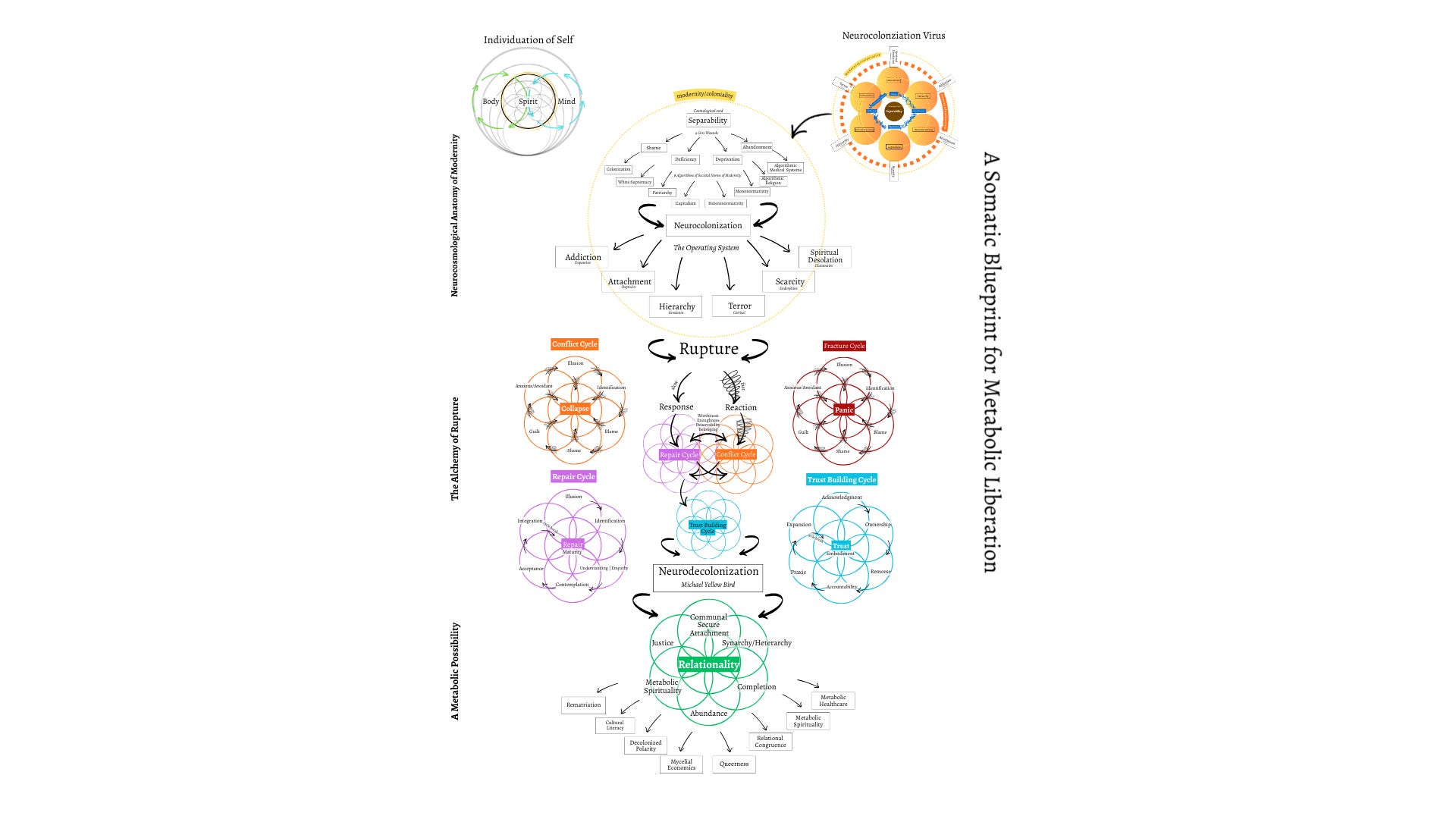
What I have tried to map through the neurocolonization virus is the way these civilizational forces condense into psychic and relational imprints that circulate through the body as shame, abandonment, deprivation, and deficiency. Shame becomes the private theology of unworthiness, the quiet conviction that if something beautiful is happening, if love is arriving, if one is finally seen, then exposure will inevitably be followed by rejection.
